


There is a lot of competition in the market, so you have to stand out from others. You can get info on over 500,000 brands from around the world until March 2025. How can you make your business stand out and build long-lasting relationships? The answer lies in some unique and smart ideas for branding your business.Branding is more than just an image or a slogan; it's about connecting with people on an emotional level.
Research highlights that about 75% of the products we buy are based on our demand. This is why business branding ideas are so important to your success. Nike, Apple, and Zopa are all very successful companies that have used branding to make their logos and slogans stand for trust, creativity, and dependability. You didn't just hear about these brands; they worked hard to make their names known in creative ways that really connected with their buyers.
We’ll explore 12 proven business branding ideas to help you differentiate your business, foster loyalty, and achieve long-term growth. Let's get right to it, then!
Why Business Branding Ideas Matter

Before diving into strategies, let’s understand why business branding ideas are crucial:
Differentiation: Being a standout in a competitive marketplace involves emphasizing your unique value. Drift, a conversational marketing platform, is a specialist in human-to-human conversations and differentiates itself from competitors.
Recognition: Building recognition and trust through repeated visual and verbal signals means customers recognize your brand instantly. Consider ASOS, whose youthful and friendly content is so perfectly aligned with its target millennial and Gen Z customer base.
Loyalty: Creating bonding turns customers into advocates. Lululemon and Vans have cultivated cult-like followings by fostering deep ties with their communities.
Growth: A strong brand attracts investors, employees, and partnerships. According to LinkedIn , companies with a strong employer brand attract 50% more qualified candidates at half the cost per hire.Now that we’ve established the importance of business branding ideas, let’s gain insights on actionable strategies to implement them effectively.
Essential Business Branding Ideas and Strategies
Branding is not one-size-fits-all. It requires a strategy that is specially made for your company goals, target audience, and industry trends. To help you develop an effective branding strategy, let's go over some of the most effective kinds of business branding strategies and their fundamental roles. Knowing these techniques, you can establish your brand heard in the competitive market of the current era as well as foster stronger connections with your audience.
Popular Types of Business Branding Strategies
Individual Branding
Individual branding means creating a unique identity for each of your products or services. This is an especially good approach for companies with multiple products or services under one corporate roof. For example, Procter & Gamble uses individual branding to separate Tide, Pampers, and Gillette so that each relates in its own manner with its target audience.
Name-Brand Recognition
Name-brand recognition leverages the reputation of a well-established parent brand to promote new products or services. Take Apple—every product they release benefits from the trust and allegiance built up around their iconic brand name. That is the ideal strategy for proven businesses with robust heritage and dedicated customers.
‘No Brand’ Branding
Considering the minimalism, ‘no brand’ branding strips away flashy elements for simplicity and functionality. Muji focuses on quality and practicality instead of flashy marketing. This strategy appeals to consumers who value authenticity and understated elegance.
Attitude Branding
Attitude branding centers on developing a unique human personality that echoes with your audience. For example, Red Bull uses the strategy of being bold, adventurous, and energetic. This kind of branding establishes relation and makes your brand more relatable and memorable.
Private Labels
Private label branding is a retail business model where retailers manufacture their own branded products for sale, typically at a lower price point than high-end brands. Walmart’s Great Value products are a prime example. Companies can make an affordable option while keeping control of price and distribution, through this strategy.
Crowdsourcing
Crowdsourcing allows customers to take part in creating your big-picture brand image. One such program is LEGO Ideas, in which fans can submit designs for new sets, and the community then votes on them. This engagement-building process will only lead to greater loyalty.
Brand Extension
Brand extension is when an existing brand expands into new categories or markets. Amazon started out as an online bookstore. It also features cloud computing (AWS), streaming services, and smart home devices. This new development is used to take on new challenges.
Even though there are different kinds of brands, their main goals are always the same. Here are the key goals every branding strategists should aim to achieve:
- Deliver a Clear Message to Your Audience.
- Authenticate Your Brand’s Credibility.
- Bring People Emotionally.
- Build Customer Loyalty.
- Influence Purchase Decisions.
Implementing the right branding strategy can set your business apart in a crowded marketplace. Whether you choose individual branding to highlight product diversity or attitude branding to evoke emotion, the key is consistency and alignment with your audience’s needs. Remember, branding isn’t just about visibility—it’s about creating meaningful interactions that resonate deeply with your customers.
12 Excellent Business Branding Ideas To Inspire
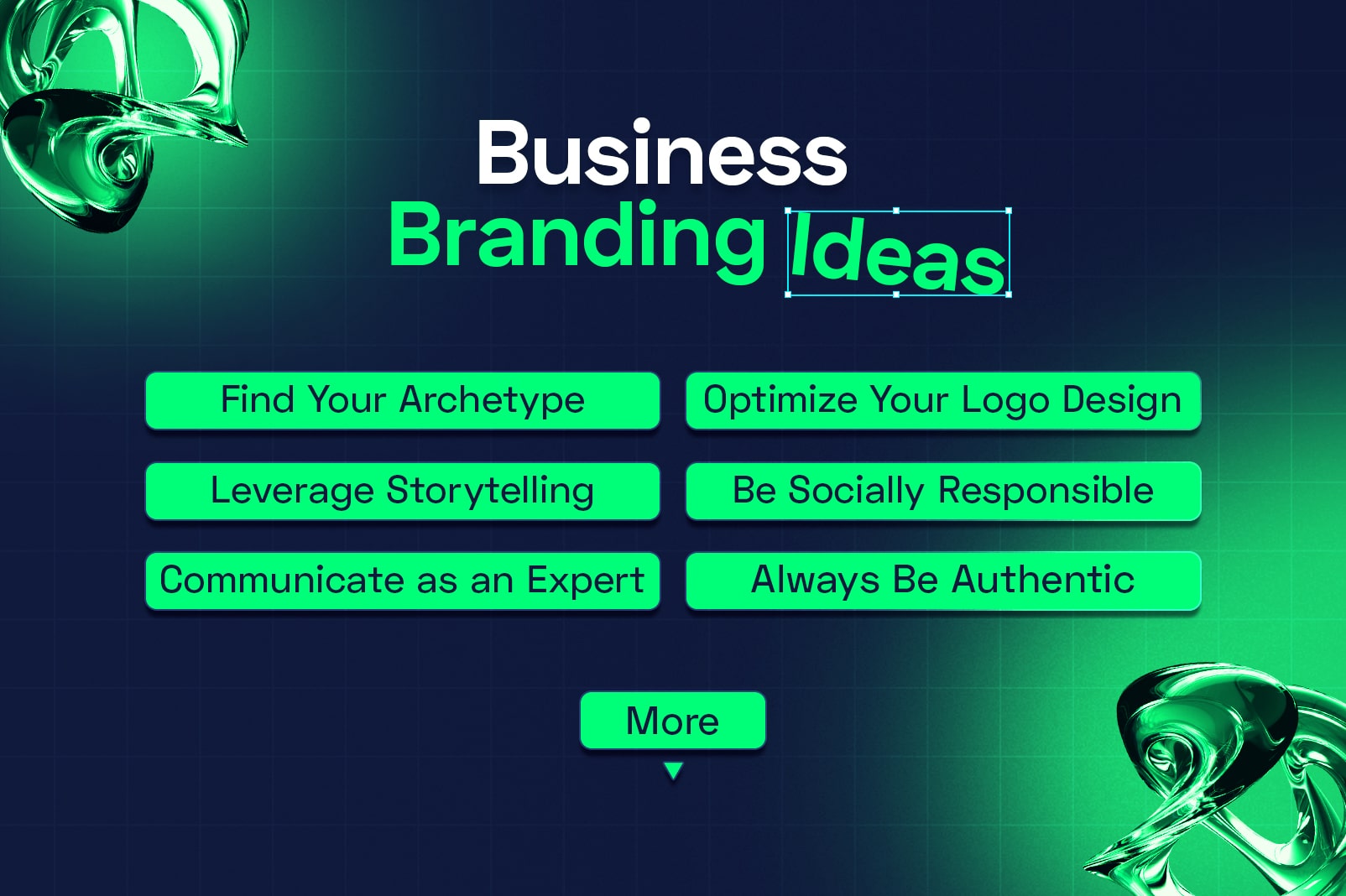
We assume most of us believe branding is only about differentiation within a clunky marketplace or in persuading people to choose your product against all the other competing products. And that is some of it, but true branding is beyond this—creating relationships with people in a certain human way through fulfilling their demands, solving their problems, and establishing trust with them.
In other words, amazing branding ideas do not just promote a product or service. They also deliver real value and appeal to your customer. In order to achieve this, you must have a clear understanding of what your customers want, hurt, and anticipate.
Once you’ve gained these insights, the next step is to craft and execute branding strategies that align with your audience’s needs, bringing your vision to life. Here are some innovative and actionable business branding ideas designed to elevate your brand’s identity, visibility, and impact in no time—
- Find Your Archetype.
- Personalize Your Branding Strategy.
- Optimize Your Logo Design.
- Leverage Storytelling.
- Improve your Social Media Presence.
- Create Engaging Video Content.
- Work Together with Influential People.
- Be Socially Responsible.
- Be Consistent Across Channels.
- Ask for Customer Feedback.
- Communicate as an Expert.
- Always Be Authentic.
Here’s a list of branding ideas for your business. Now, let’s get into the details!
1. Find Your Archetype
Brand archetype is the character that tells your business’s story and gives you an identity. Psychologist Carl Jung described archetypes as universal types that express different aspects of our personality through phases of our lives.
These archetypal characters are central to many successful brand storytelling strategies. For instance:
- Taco Bell is the Jester, using humor and irreverence to endear itself to younger audiences.
- It is the company that creates the world-changing technology.
- Windows performs as a friendly neighbor and has its identity in smoother and more reliable usage.
These archetypes help craft compelling narratives that resonate with audiences. By identifying your brand archetype, you can design stories that make your client feel understood and valued. Need help defining your brand archetype? Our Case Studies are here to see how we’ve helped businesses uncover their unique identities.
2. Personalize Your Branding Strategy
There is a big demand for personalization among the consumers. Either it can be a name, customized suggestions, or soliciting feedback. Make your perspective feel respected using business branding ideas such as customized emails or targeted products.Taco Bell uses its social media posts to embody its Jester archetype, posting with humor and relatable content. ASOS, too, benefits from personalization with product recommendations during shopping.
Here’s how you can personalize your strategy:
Address everyone personally: Use individual names in your communications.
Acknowledge their unique identity: Recognize what makes each customer special.
Ask questions: Engage your authority by asking for opinions, experiences, or suggestions.
Be relatable: Talk to your audience in a way that makes your business feel human and approachable.
If you need help with a social media strategy, reach out to top experts. Their knowledge and experience can help you succeed.
Want to take your personalization efforts to the next level? Contact our Services team to learn how we can help you craft tailored campaigns.
3. Optimize Your Logo Design
Your logo is the face of your brand. Invest in a professional, unique design that aligns with your brand personality. Minimalism is trending in 2025, so aim for simplicity and scalability. Notes to follow: Nike’s swoosh speaks volumes without words. Looka’s AI-powered logo creator crafts brand identity effortlessly. But designing a logo takes a considerable amount of time depending on the brand. This is why you must have a deep and clear understanding of who your customers are and how they see you. Spend time identifying your brand personality and exploring the best way to visually convey that personality.
Note that a logo is not fixed in space-time. It changes over time. If your brand really has shifting identities, design a logo that is relevant and on-trend. Gather feedback from your target demographic and internal team and use this information to influence your design process.You can recreate an on-trend brand logo that accurately depicts your brand and story and is memorable. Ready to revamp your logo?
4. Leverage Storytelling
Storytelling creates connections. Share your business history, unveil your employees, or reveal happy customers in testimonials. IKEA is one of the best examples of brand storytelling by showing how its products make spaces.IKEA's 1950s catalog departed for furniture advertising by developing photo shoots with products displayed in common settings. The approach narrated a story about how customers would be able to design their room using IKEA products, making the products more attractive.
Storytelling is also pictured into every IKEA campaign. IKEA's Great Indoors TV ad features a lion relaxing at home. The ad shows how IKEA products can optimize space and make a home that’s you fit. Looking for inspiration? Go to our Blog page for pro tips on writing irresistible brand stories.
5. Improve your Social Media Presence
Social media can be a very powerful tool for business branding ideas. Choose listening networks and communicate in a genuine manner. Post behind-the-scenes content, respond promptly to queries, and use polls to interact.Today’s consumers are less likely to be swayed by traditional advertising. Instead, they prefer hearing from people who are authentic in their views and represent them.Hence,influencer marketing has become increasingly popular.For example, Daniel Wellington gained global recognition by collaborating with niche influencers. Partnering with micro-influencers (those with fewer than 100,000 followers) often yields better results because they target niche markets and interact frequently with their audience. Want to amplify your social media strategy? Visit our Contact Us page to schedule a consultation with our experts.
6. Create Engaging Video Content
Videos are the preferred medium for absorbing information. Use them to showcase your brand personality, educate customers, or highlight user-generated content. Tools like Spotify Wrapped demonstrate creativity in action.
Spotify has successfully mastered interactive content with its iconic Spotify Wrapped Year-Round. Through ingenious creativity, the app used customer data to summarize what users had been listening to throughout the year. It even assigns your musical personality, making it one of the year’s most awaited branded events.
Increasing interaction can be simple. Data from Statista reveals that the most effective marketing tool, as reported by marketers, is interactive email.
7. Work Together with Influential People
Influencers can amplify your reach. Partner with micro-influencers who align with your values. Daniel Wellington gained global recognition by collaborating with niche influencers.
Recognizing influencers' power early in shaping people's perception of a brand expanded Daniel Wellington to success. It partnered with influencers from different communities and industries, such as fashion designers, artists, travel vloggers, etc., to promote their brand by posting UGC with #DWpickoftheday.
The brand ensured representation of its diverse people on social media platforms like Instagram and Pinterest. Soon, the brand gained recognition worldwide and sold one million watches three years after its campaign launch.
8. Be Socially Responsible
Consumers support brands that give back. Align with causes that reflect your values. We can consider:
- Pela Case, which uses biodegradable materials to protect the planet.
- Colored Organics creates sustainable baby apparel.
Chief Marketing Officer Gareth Everard explains, "We’re considering every step of the process, from offsetting carbon emissions of production factories down to deciding between air or ocean shipping." Pela Case is deeply affected by such sentiment.Based in Minnesota, Colored Organics specializes in making low-cost organic baby clothes from sustainably sourced materials, for children. They also use natural dye, so everything is good for your baby and the environment.
9. Be Consistent Across Channels
Consistency builds trust. To maintain consistency in messaging, visuals, and tone, enable a brand guide. Whether it’s your website, social media, or packaging, every touchpoint should reflect your identity.
According to MarketingNutz, it takes up to 5-7 brand impressions before an individual can recall your brand. From the website to social media channels and offline interactions with customers, branding must be consistent. You should focus on brand guidelines to reinforce cohesiveness.If your brand voice reachable to youthful and casual on socials, then there’s no need to be stiff on your blogs. Your customers should know what to expect or feel once they see your content, logos, or other brand assets. Consistency builds familiarity, trust, and loyalty. These feelings reflect successful branding.
10. Ask for Customer Feedback
Engage your customers through surveys and gather their opinions on topics that matter to your business. Keep the survey concise and thank participants for their time.
Figure out the right questions to get to know your recipient better—who they are, what motivates them, and what they aspire to achieve.
When you get feedback, embrace both praise and criticism. Use this valuable information to improve your products, services, or marketing strategies to continually meet your customers’ needs.
11. Communicate as an Expert
Write what you know; build your credibility flow into your blog with valuable insights that make you the leading authority in your niche.ASOS fills its blog with young and fun content that appeals to millennial and older customers. The engagement they will get is a great signal for their readers.
12. Always Be Authentic
Be open about what is good about you and what is less so. Honesty is what customers value and tend to trust a brand more if it accepts its faults.Patagonia , honestly acknowledges its environmental issues and its efforts to overcome them. Being honest in this way builds trust and makes the brand look like it cares about society.
Related Article: https://olynex.com/blog/top-ux-agencies-in-usa-2025 (logic: criteria reflecting these comes from well-known agencies)
Your Creativity Matters to Establish Failproof Branding Ideas
Effective business branding ideas only succeed when they are backed by an actionable plan. Getting ideas together without a clear plan to put them into action won't get you the results you want. To make a difference, you need to be smart and creative at the same time.People no longer have to use the old ways of branding in a world where everything is digital. You can promote your business in a huge number of ways, such as through social media, email campaigns, websites, and even interactive content. You should be smart and clever when you have so many tools at your disposal. This information will be very helpful in creating branding strategies that really connect with them.
A great branding idea can leave a impression on your buyers. It turns your company into one that people love and support. This connection can make your workers and clients more loyal, help you make more money, and build stronger relationships over time.So, have you found those brand ideas that work for your business? Make sure your plan is creative, smart, and adaptable no matter what path you choose. When you combine imagination with action, you can reach new heights and leave a mark that lasts for years to come.
Frequently Asked Questions
What fresh thoughts do you have for a small business?
Small businesses can use tactics such as storytelling, targeted messaging, and influencer partnerships to have an impact. Create your brand archetype and speak in a way that your audience gasps when they read your words.
How can I better describe my personal brand on the Internet?
Focus on optimizing your website, creating social media content, and using SEO to get your brand on the first page of results. Use tools such as Google Analytics to track performance and refine your approach.
Why is consistency so important in branding?
It is so because consistency creates trust as well as recognition. When your messaging, visuals, and tone are consistent across practices, customers see your brand as both reliable and professional.
How can I measure the success of my branding efforts?
Track metrics for website traffic, social media engagement, and customer feedback. Tools like Google Trends and surveys can provide valuable insights into how your brand is perceived.
What makes a brand memorable?
A memorable brand combines a unique logo, consistent messaging, and emotional storytelling. Brands that solve real problems and connect with their audience on a personal level leave a lasting impression. Read our Testimonials to see how we’ve helped businesses achieve their goals.
By Faieq Hamim | Updated Mar 22, 2025